Web Apps Aren’t Just Dashboards Anymore, They’re the Brain of Scalable AgriTech Robotics

If you are an AgriTech founder, product manager, software architect or a front-end architect in 2026, you already know the narrative has shifted. The digitalization of the agricultural sector is no longer just about building a dashboard to display yesterday's soil moisture levels.
We are facing severe labor shortages, unpredictable climate changes, and the urgent need to maximize yield per acre. Driven by these pressures, autonomous agricultural fleets encompassing driver-less tractors, automated seeders, precision weeding robots, and specialized robotic harvesters are moving from experimental pilot programs to widespread commercial deployment.
For developers and founders, this rapid hardware evolution necessitates an equally radical transformation in software architecture. Your web application can no longer function as a passive record-keeping tool. To manage fleets of autonomous robots operating in unstructured, unpredictable rural environments, the web app must evolve into a real-time, interactive command center. It must serve as the cognitive engine, the brain that orchestrates scalable AgriTech robotics.

To achieve this, modern web applications must natively support three critical technological pillars:
Browser-based 3D simulation and Digital Twins for testing robot paths before physical deployment, protecting expensive hardware investments.
Real-time transport layers (WebSockets & WebRTC) operating over robust offline-first architectures that integrate seamlessly with existing Indian Digital Public Infrastructure (DPI).
Agentic Artificial Intelligence embedded directly within the application layer for autonomous, multi-step decision-making.
Here is a practical, architectural deep-dive into how modern web technologies are orchestrating the future of precision agriculture, and how founders can build highly scalable, ROI-driven command centers.
The Paradigm Shift: From Passive Telemetry to Agentic Command Centers
To fully grasp the magnitude of this architectural evolution, contrast the legacy operational lifecycle of agricultural machinery with a modern robotic harvester controlled via a mobile web app. Early IoT solutions provided farm managers with remote dashboards, but these systems were plagued by high latency, passive data consumption, and a fundamental inability to execute complex, bidirectional control loops.
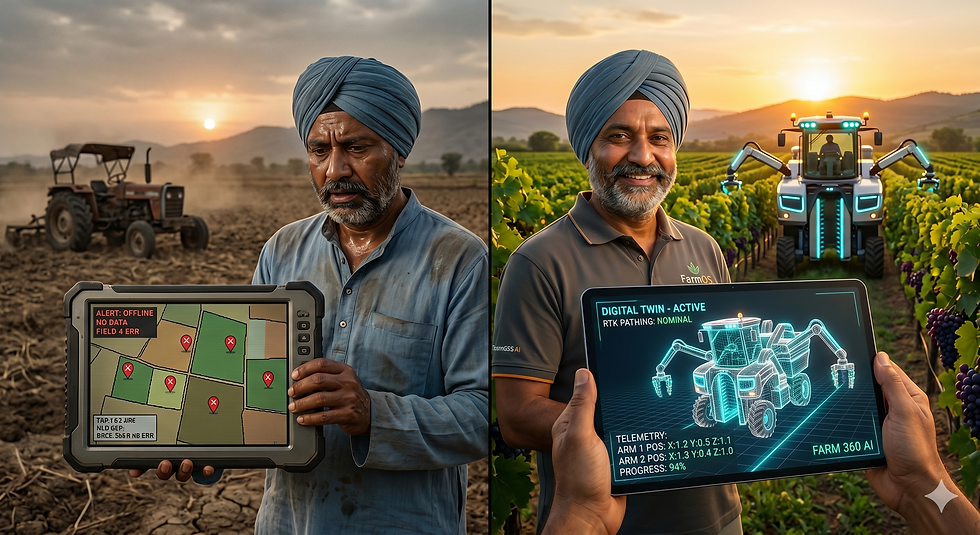
Today's web application bridges the gap between passive observation and active, agentic control. To illustrate this transition, here is a conceptual before-and-after diagram of a farmer utilizing a mobile phone to control a fleet of robotic harvesters:
Operational Vector | Before: Passive Telemetry | After: Agentic 3D Command Center |
Data Transport | Harvesters upload batch telemetry (GPS, battery) via HTTP REST calls every 15 minutes. | The web app maintains a persistent WebSocket connection for instant telemetry and a WebRTC UDP channel for sub-500ms live video streaming. |
User Interface | The farmer's screen displays a static 2D map with stale location pins. | The device renders a real-time, browser-based 3D digital twin. The robot's spatial orientation animates at 60 FPS natively in the browser. |
Obstacle Resolution | The robot halts at a fallen branch and throws an error code. The farmer travels to the field for manual override. | The anomaly is streamed to the web app. Agentic AI evaluates spatial parameters and presents the farmer with a visually simulated "Suggested Reroute." |
Network Resilience | Complete loss of visibility and control the second the cellular signal drops. | Offline-first Progressive Web App (PWA) architecture uses local IndexedDB storage to maintain operations and automatically syncs when connectivity returns. |
This transition requires highly specialized frontend engineering, combining high-performance 3D rendering engines, complex networking protocols engineered for scale, and edge-native AI execution loops.
Pillar 1: Browser-Based 3D Simulation and the NVIDIA Ecosystem
Unlike structured warehouse floors, Indian farms feature irregular terrains, narrow passages, dynamic biological obstacles, and rapidly changing soil conditions. For an AgriTech founder, deploying a multi-ton robotic harvester without prior spatial validation is a massive financial risk. A collision could damage expensive hardware or destroy delicate, high-value crops.
Modern AgriTech web applications mitigate this risk by incorporating advanced 3D simulations. This allows operators to test, visualize, and optimize robot paths dynamically before physical execution.
Leveraging the NVIDIA Omniverse and Isaac Sim Ecosystem
For enterprise-grade robotics, rendering these physics natively in the browser requires a robust backend engine. By 2026, the industry standard has shifted toward the NVIDIA Omniverse ecosystem, specifically utilizing NVIDIA Isaac Sim 6.0. Isaac Sim provides the heavy lifting: multiple physics backends, highly accurate sensor simulation (like RTX-Lidar), and environments built on Universal Scene Description (OpenUSD).
Instead of forcing farmers to download massive desktop applications, developers can now use NVIDIA's modular library-based architecture (ovrtx, ovphysx) to run these heavy simulations headlessly on cloud servers. The resulting data or a direct WebRTC stream is then piped directly to the frontend web application, allowing the farmer to view the complex physics simulation on a standard mobile browser.

On the physical robot itself, the NVIDIA Jetson platform (such as the Jetson AGX Orin) runs real-time edge AI inference, ensuring that the machine can process computer vision and navigate autonomously even when disconnected from the central web app.
Front-end Implementation: Three.js vs. Babylon.js and WebXR
To render these digital twins and path visualizations on the client side, frontend architects rely on WebGL/WebGPU libraries. The two dominant choices are Three.js and Babylon.js, and choosing between them depends on your startup's needs:
Three.js: A lightweight, unopinionated rendering library. It is excellent for building fast, minimalistic pathfinding visualizers with incredibly small bundle sizes (under 200kb). However, it lacks built-in physics and advanced GUI systems, requiring you to build your own Entity Component System (ECS) from scratch.
Babylon.js: Designed as an "Engine-as-a-Service," Babylon.js is heavier but comes production-ready out of the box. It features native integration of physics engines (PhysicsImpostor), advanced collision detection, and crucially, a built-in WebXR manager.
WebXR for Remote Maintenance: Integrating WebXR capabilities is becoming a game-changer for AgriTech software. When a robot breaks down in a remote field, Babylon.js allows developers to stream a Mixed Reality (MR) overlay directly to a technician's web browser or headset. Utilizing the WebXR Device API, the web app can superimpose diagnostic telemetry and 3D repair guides directly over the physical machinery, allowing an expert hundreds of miles away to guide a local farmhand through complex repairs without needing native apps.

Pillar 2: Real-Time Fleet Monitoring and Hardware Integration
A fleet of hundreds of autonomous robots generates massive volumes of telemetry. For Indian AgriTech founders, the biggest technical hurdle isn't the data volume, it's the rural network topology. Managing this requires ensuring reliable synchronization across flaky networks and deep integration with existing digital infrastructure.
Fleet Monitoring in the Wild: The Niqo Robotics Architecture
To see this in action, we can look at Bangalore-based Niqo Robotics, a pioneer in AI-powered spot-spraying robots designed for the Indian agricultural landscape. Niqo addresses the problem of uniform pesticide spraying by deploying computer vision models that differentiate between crops and weeds, reducing chemical usage by up to 60%.
Managing this physical fleet relies heavily on robust software architecture. The local robot processing is handled by edge AI computing platforms like NVIDIA Jetson. However, the control and monitoring of these machines are handled through dedicated web and software dashboards:
Niqo Track: A secure, web-based online dashboard that serves as the central command center. It allows farm managers to log in from anywhere to track their entire autonomous fleet, providing a bird's-eye view of spraying operations, field coverage, and hardware status.
Niqo View: An in-cabin software interface that allows a local operator or driver to manage the robotic spraying operations via a simple touchscreen, offloading the complex AI processing to the background.
This architectural split is heavy edge inference on the machine, combined with lightweight, real-time web dashboards for human oversight and its is the blueprint for scalable AgriTech.
Offline-First Architecture and Progressive Web Apps (PWAs)
Because startups like Niqo Robotics operate in remote areas, their web architectures must prioritize "Offline-First" design. If the cellular signal drops, the command center cannot crash.
Modern architectures utilize Progressive Web App (PWA) methodologies. By utilizing standard browser APIs such as IndexedDB for local structured data storage and Service Workers for caching the UI, the app loads instantly in dead zones. Furthermore, developers leverage the Periodic Background Sync API. This allows the web app to cache operational commands (like new spray routes) locally and silently synchronize that data with the primary cloud server the moment the mobile device re-enters a coverage zone, ensuring no data is lost.
WebSockets & WebRTC: The Transport Layer
To transmit live telemetry (GPS, battery, heading) to dashboards like Niqo Track, standard HTTP polling is inadequate. You must scale WebSockets for continuous, bi-directional, stateful communication. Because WebSockets guarantee ordered packet delivery, they are the ideal protocol for sending precise, high-stakes navigation waypoints.
However, for live video streaming (necessary when a farmer needs to manually teleoperate a stuck robot), WebSockets fail due to TCP Head-of-Line blocking. Here, developers must implement WebRTC. Running primarily over UDP, WebRTC skips dropped frames rather than pausing the stream, ensuring ultra-low-latency (sub-500ms) video feeds even over poor rural cellular networks.

Integrating with India's AgriStack (Digital Agriculture Mission)
A major differentiator for successful AgriTech startups in 2026 is interoperability with India's Digital Agriculture Mission, specifically AgriStack. AgriStack operates as a digital public infrastructure (DPI) featuring open API gateways.
For developers, this means your web backend no longer needs to manually verify farm boundaries or crop types. By integrating with the AgriStack API, your fleet monitoring system can instantly pull verified Farmer IDs and plot-level data from the Digital Crop Survey (DCS).
Your robot's command center instantly knows who it is working for, what crop it is harvesting, and the precise geo-fenced boundaries of the plot, drastically reducing onboarding friction for new farmers.
Pillar 3: Agentic AI and Autonomous Orchestration
The final evolutionary step is the deep integration of Agentic AI. Generative AI summarizes text; Agentic AI turns knowledge into action. An AI agent continuously perceives its environment, reasons about context, plans a sequence of actions, and interacts with external APIs and hardware to achieve a goal.
In a modern agricultural setting, this manifests as a multi-agent system forming a closed-loop ecosystem. For example, "sensing agents" deployed in the field (monitoring soil and weather) feed data to a central "supervisory agent" living in the web backend. This supervisory agent uses a Large Language Model (LLM) to reason through the data and autonomously dispatch commands to the physical execution layer—the robotic harvester.
The Developer Workflow: Vercel AI SDK & GitHub Copilot SDK
Building these agentic loops from scratch is complex. Today, frontend architects leverage tools like the Vercel AI SDK and the GitHub Copilot SDK.
The Vercel AI SDK allows developers to seamlessly integrate multi-step agentic loops into Next.js or React applications. The core mechanism is Tool Calling. A developer defines a tool (e.g., calculate_evasion_path or fetch_harvester_telemetry), and the LLM autonomously calls these backend functions based on the farmer's prompt.
Simultaneously, the GitHub Copilot SDK allows developers to embed the exact same agentic execution loop that powers Copilot directly into their proprietary web applications. This includes native support for the Model Context Protocol (MCP), standardizing how AI agents connect to external enterprise tools.
Hooking into Bharat-VISTAAR for Localized Intelligence
The true power of these agents in the Indian context is unlocked by connecting them to Bharat-VISTAAR. Launched by the Government of India in February 2026, Bharat-VISTAAR is a nationwide, multilingual AI-powered Digital Public Infrastructure.
Using MCP, a developer can link their web app's agentic AI directly to Bharat-VISTAAR's network. Consider this workflow:
The robot's edge sensors detect an unrecognized pest on a crop and send the image via WebSockets to the web app.
The web app's Agentic AI queries the Bharat-VISTAAR API to cross-reference the image against ICAR's National Pest Surveillance System.
Bharat-VISTAAR identifies the pest and returns the localized, scientifically backed treatment protocol.
The Agentic AI immediately adjusts the robotic fleet's pesticide spraying parameters and translates the advisory into the farmer's local language (e.g., Hindi or Marathi) for explicit approval via the web UI.
The Human-in-the-Loop (HITL) Imperative
Because we are dealing with heavy machinery and high-value crops, fully relinquishing control to AI is dangerous. Modern web apps must implement Human-in-the-Loop (HITL) safeguards. Using the Vercel AI SDK, when the agent calculates a complex rerouting path or a new chemical spraying regimen, it pauses execution and streams a custom React component to the dashboard. The farmer must visually review and approve the action before the final command is dispatched to the robot.
Conclusion: The Future of Software Development for Scalable AgriTech Robotics Architectures
For AgriTech founders and developers, the web application has transcended its origins as a passive reporting tool. It is now the centralized brain of the agricultural operation.
By unifying high-fidelity 3D physics from NVIDIA Isaac Sim via WebGL, ensuring resilient real-time teleoperation via WebRTC, and embedding Agentic AI capable of interfacing seamlessly with India's AgriStack and Bharat-VISTAAR networks, developers are building the systems that will secure the future of global food production.
The web application will no longer simply monitor the harvest; it will intelligently, safely, and autonomously execute it.


Comments