5 Disruptive Trends Transforming the Indian Heartland: The Rise of Drones and IoT

The High-Tech Reimagining of the Indian Farm
For decades, the story of the Indian farm was one of backbreaking manual labor and seasonal gambles. Today, that narrative is being disrupted. A high-tech revolution is sweeping through the heartland, as agritech startups dismantle the barriers between smallholder farmers and industrial-scale precision.
The central question for the modern strategist is no longer about the viability of technology, but its accessibility. How does a two-acre farmer harness the same power as a massive plantation? The answer lies in the convergence of two critical technologies: ground-level IoT sensors and "Drone-as-a-Service" (DaaS). This is a precision-driven leap that turns the sky into a workspace and the soil into a live data stream.

The End of Ownership: The Rise of "Drone-as-a-Service" (DaaS)
Ownership is becoming a liability in the high-speed world of agricultural hardware. In the past, the staggering upfront cost of a drone was a non-starter for the average farmer. Today, the model has shifted from capital expenditure to a flexible, pay-per-acre rental model.

Pioneers like Garuda Aerospace, IoTechWorld Avigation, and Vaimanika Aerospace are leading this charge. By providing professional-grade aerial spraying and mapping on demand, they have democratized the sky. This shift allows farmers to deploy sophisticated technology without the burden of maintenance or obsolescence.
Hardware like the "Agribot" and the "Kisan Agri Drone" is effectively replacing hazardous manual labor. These GPS-guided tools deliver automated, precise pesticide application, removing humans from the direct path of chemical exposure.

This service-led transformation is the great equalizer, providing smallholder farmers with the same competitive edge as large-scale agribusinesses.
The Soil’s "Digital Pulse": Real-Time IoT Monitoring
If drones own the sky, IoT sensors are mastering the earth. Ground-level sensor networks are replacing traditional guesswork with a "digital pulse" that monitors the soil's health in real-time.
Companies such as Proximal Soilsens Technologies (incubated at IIT Bombay) and Fyllo have moved beyond theoretical data to field-ready hardware. With products like "TerraPort," "NutriSens," and the "SHOOL" sensor from NEERX, farmers can now view automated insights on their mobile devices instantly.
These systems track the vital signs of the field:
NPK Levels: Real-time monitoring of Nitrogen, Phosphorus, and Potassium for exact fertilization.
Moisture and pH: Maintaining the perfect environment for root health.
Salinity and Microclimates: Tracking salt levels and local weather conditions at the crop canopy level.

The strategic value of this data is undeniable. In specialized pilot programs, these IoT systems have demonstrated a 22% saving in water and electricity and a 20% improvement in yield specifically for potato crops.
From Billions of Liters to Precision Drops: The Sustainability Impact
The agricultural revolution is moving away from the era of "flooding fields" and toward a future of "precision drops." Traditional irrigation often relied on visual guesswork, leading to massive resource waste and chemical runoff.
The industry is now pivoting toward fertigation—the sophisticated, simultaneous application of water and liquid fertilizers based on real-time soil needs. This data-driven approach ensures that every drop of resource is utilized by the plant rather than lost to the environment.
The impact is measurable: Startup Fasal reports that its IoT-driven deployments have saved an estimated 3 billion liters of irrigation water, proving that sustainability and high-yield profitability are not mutually exclusive.
The Integration Frontier: Creating the "Farm’s Central Nervous System"
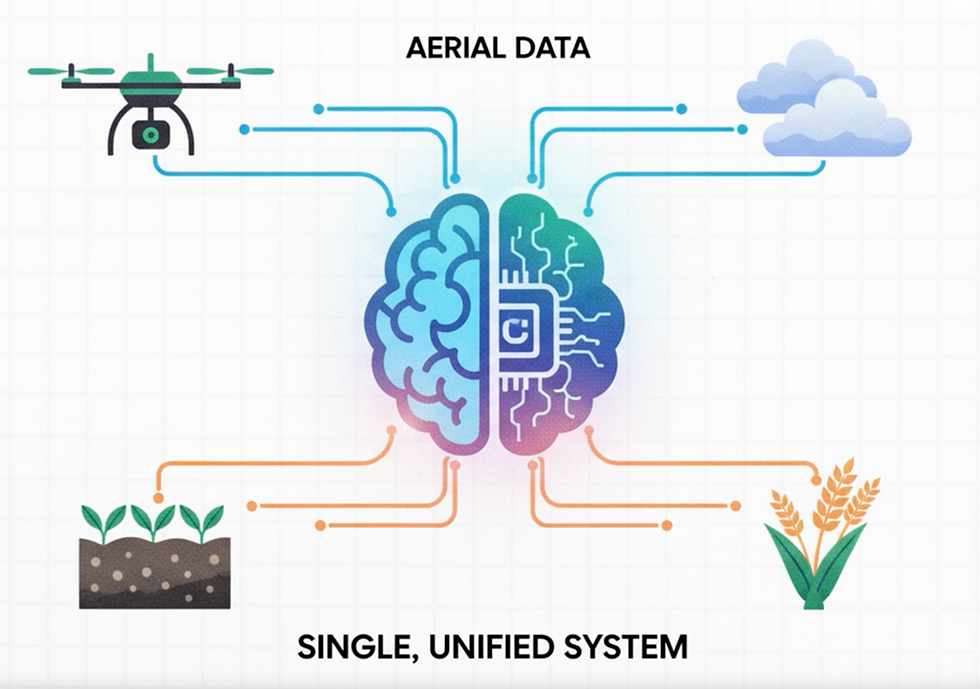
The most significant market opportunity in Indian agritech today lies in the "unsolved gap": the full-stack integration of overhead and underground data. While many players specialize in one domain, the future belongs to platforms that can synthesize both.
Enterprises like Cropin, BharatRohan, and AgriPilot.ai are building the "central nervous system" of the modern farm. These platforms ingest data from both on-field IoT sensors and overhead drone or satellite imagery.
Crucially, companies like General Aeronautics and BharatRohan are now bridging this gap, using drones to collect real-time soil and crop health data to inform their delivery models. This holistic oversight allows for advanced yield forecasting and disease risk mapping, creating a unified dashboard for the entire agribusiness ecosystem.

The Economic Engine: Subsidies and the "Drone Mart" Ecosystem
The acceleration of these technologies is fueled by a robust economic and policy framework. The government’s Sub-Mission on Agricultural Mechanization (SMAM) provides the subsidies necessary to move these tools into the hands of the many.
Central to this distribution are Farmer Producer Organizations (FPOs) and centralized marketplaces like the AP Drone Corporation (Drone Mart), which connect technology providers with rural communities.
Perhaps most surprisingly, social media has become the new town square for agritech. While enterprise-level deals happen in boardrooms, Instagram has emerged as the premier marketplace for finding local drone operators. This decentralized digital ecosystem allows individual operators to share field testimonials and connect directly with villages, bypassing traditional corporate friction.

Conclusion: The Future is Underfoot and Overhead
India’s heartland is no longer just a place of tradition; it is a laboratory for innovation. From the quiet hum of a drone overhead to the silent, solar-powered sensors buried in the soil, the "digital pulse" of the farm is growing stronger.
By removing the barriers of high capital costs and replacing intuition with raw data, agritech is securing the nation’s food future.
In a decade, will we still call it "precision farming," or will this simply be the standard way we feed the world?


Comments